
The Loveland Frogman

Loveland Frogman

Nicknames:  Loveland Lizard

Location: Loveland, Ohio

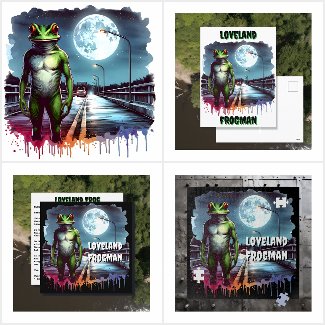
This creature is said to be a humanoid frog like animal that is roughly 4 feet tall. It has been sighted numerous times in Loveland, Ohio.

It was first spotted in 1955 by a businessman, in a Branch Hill neighborhood describing it as a frog like creature that stood up on two legs.

On March 3, 1972, a police officer reported seeing a similar creature that ran in front of his car in Loveland, Ohio. He said at first it was scrunched down on the ground but then stood up quickly onto it’s back legs.

Facts & Trivia

  • In 2016, a policeman called a news station saying that he had shot and killed a creature that resembled descriptions of the Frogman, but later it was identified as a large iguana that was missing its tail.
  • The Loveland frog became the city's mascot in 2023.
  • There is a musical made about the Loveland Frogman called, “ Hot Damn! It's the Loveland Frog!”.
So, what do you think? Is this a mythical creature that appears out of nowhere to scare the Loveland residents? Or maybe just a Iguana that had an unfortunate mishap that made him lose his tail? Tell us below in the comments if you have had any sightings of the Loveland Monster. 


And stop by our My Paranormal Shop to check out our Loveland Frog merch!


Comments

Popular posts from this blog

Wendigo

Wendigo Winter Entity From the folklore of tribes in North America, the Wendigo is a humanoid-like evil spirit that likes to possess human beings and turn them into cannibals. It is said to be super tall, gaunt and look emaciated and shifts between looking human to looking like a human with a stag head. Facts & Trivia Some Indigenous people thought that the Wendigo was a sign of people’s selfishness and greed. Many mental illnesses were blamed on a person being possessed by a Wendigo. A person was said to turn in to a Wendigo by doing bad things, being cursed by a Shaman or by dreaming about it. Wendigos were first written about in the 1600's. The Algonquian speaking people believed that eating fatty meat could cure one of being a Wendigo.

Mongolian Death Worm

  Mongolian Death Worm Allghoi or Olgoi-khorkhoi It is said to be a reddish 2 - 5 foot long worm with a red mouth. Folklore says it lives under the sand in the Gobi desert, and will come out to kill it’s prey with it’s poisonous spit. Some witnesses have said that the worm will spit at you. Once the spit touches the victim, it poisons the person and they will not survive. Others have said it will appear suddenly out of the sand of the desert, quickly wrapping around it’s victim, choking it, then eating it’s prey whole. In folklore, it is also said that they can generate electrical shocks to stun their victims. What Do You Think? Is the Mongolian Death Worm a real creature that lives under the sand of the Gobi Desert? If it is real, is it a supernatural creature or is it some real animal that we have not identified yet? Is it just a fun creature to make horror movies about? Would you venture into the Gobi Desert alone?

Cryptids that went from Myth to Real

Cryptids that went from Myth to Real Once thought to be myth, These creatures turned out to be real! Black Panther Did you know Black Panthers were once considered a cryptid? It wasn’t until 2018, when a photo of a black leopard was captured in Kenya that they were actually proven to exist. Bornean Bay Cat In 1992, there was a rare small breed of cat that was discovered in Bornean Baby that was once thought to be a myth. Coelacanth This fish was thought to be extinct until in 1938, when a fisherman off the coast of South Africa caught one! Giant Armadillo Folklore started in the 1800's that there was a large armadillo but was mostly believed to be a myth until in the 1970's a large 130 pound armadillo was found in South America. Giant Gorilla This large breed of gorillas was found in the 1960s in Central Africa. Giant Otter Once thought a myth, the giant otter was eventually found in South America and measured up to six feet long. Giant Pangolin The first large scaly mammal P...